
The Stories That Made Us – One Photograph at a Time
We know history through the written word, in documents and records.
It is preserved in history books and family Bibles. The most compelling history, however, is often that captured in images. The images of our history live with us the longest and can tell the story without a word spoken or written. Paintings and drawings have been with us forever, offering early insights into our most ancient history. Using them for instruction gave us an idea of the event or time in history, but it was someone’s interpretation or memory, not the event itself. The use of photographs changed the stakes, making them feel more real.
Photographs documented events of the Mexican-American War in 1847 and were used to report on the French Revolution in 1848. A few events appeared in early photographs before that, but they were not widely distributed or reproduced. Since then, photography has been used to document every event in history. In fact, they have done more than record the events. The photographs have shaped our reaction to them. For the last century and a half, photographs have been our witnesses to history, providing evidence that has greatly affected public opinion. At times, they have been used to reshape our collective memory.
Some photographs require only a name to convey the event and the historical period.
- Dorothea Lange’s “The Migrant Mother” became a symbol of the plight of migrant farm workers during the 1936 Great Depression.
- More than a picture, Sam Shere’s 1937 photo of “The Hindenburg Disaster” instantly calls to mind the anguished voice of Chicago radio announcer Herbert Morrison:
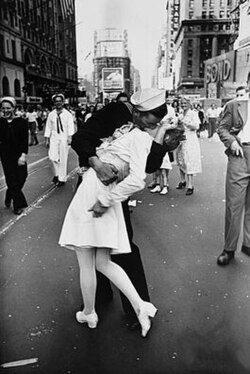
“It is bursting into flames… This is terrible! This is one of the worst catastrophes in the world… Oh, the humanity!” - The joy of a moment like “V-J Day in Times Square” is forever captured in Alfred Eisenstaedt’s 1945 photo of the sailor kissing the nurse.
- We can rejoice in the audacity of heroic acts, such as the “Tank Man at Tiananmen Square” in Stuart Franklin’s 1989 photograph.
- Each of us can recall exactly where we were and what we were doing through poignant photos of Kennedy’s assassination or the Challenger Explosion.
- President Trump’s “Fight, Fight, Fight” photo, captured by Evan Vucci, created an almost mythological moment for the candidate that helped propel him to victory in 2024.
Long before most Americans read a detailed account of the American Civil War, they had seen the faces of exhausted soldiers or the still forms of the dead at Antietam. Before studying the speeches of Martin Luther King Jr., they had seen black-and-white photographs of children bracing against fire hoses in Birmingham. Before learning the diplomatic intricacies of the Vietnam War, they had encountered the searing image of a young girl fleeing napalm. Our national resolve was strengthened by the pictures of 9/11’s barbarism and the resounding response of our first responders. History’s famous photographs expose injustice or suffering, while others capture equally powerful resilience.
The Civil War: When Americans Saw War for the First Time
When photographers like Mathew Brady carried cumbersome cameras onto Civil War battlefields, they introduced the American public to war’s unfiltered cost, especially for those who would never experience it firsthand.
In addition to being the first war fought with modern technology, the Civil War was also the first to be documented with it. Brady’s pictures ensured that the public saw the gruesome aftermath of that warfare. His photographs of Antietam and Gettysburg, among others, left nothing to the imagination. War could no longer be dramatized as glorious pageantry; instead, it was seen intimately and with devastating effect. The nation’s grief was captured and had to be confronted.
Women’s Suffrage: Reframing Women as Political Actors
The power of optics was well understood by the leaders of the women’s suffrage movement and used to their advantage. Leaders such as Alice Paul recognized that photographs could challenge entrenched stereotypes, so they projected images of disciplined parades in Washington, D.C., and showed women stoically picketing the White House.
These images demonstrated the women’s organization and resolve, while photographs of imprisonment and hunger strikes stirred sympathy, thereby creating legitimacy for the movement. The 19th Amendment, granting women the right to vote, was passed in 1920, and photographs played a major role in shifting public opinion.
The Holocaust: Photography as Evidence
Even though the Nazis were inclined to document their horrors themselves, it was the photos of Allied soldiers entering places like Auschwitz and Buchenwald concentration camps, cameras in hand, that changed the world’s perception of the reality of Hitler’s regime.
The photos of emaciated survivors, mass graves, and skeletal remains became undeniable proof and evidence. This photography became the testimony of the millions who had died and was later used as evidence in the Nuremberg Trials, shaping international human rights law. Those photographs, by the score, ensured the Holocaust could not be denied or forgotten.
Vietnam: The Living-Room War
Through video and televised imagery, the Vietnam War could be experienced live, almost in person, nightly.
The evening news captured moments that crystallized public unease: a child burned by napalm or a summary execution in the street. That televised imagery and the corresponding front-page photography turned the war into real events, showing the impact on the young men sent to fight in stark, unsettling ways.
The imagery had a dramatic effect on public opinion, which began to shift away from support for the war after 1968. Leaders realized that images could influence political will as powerfully as battlefield victories. Seeing the war in our living rooms changed the dynamics considerably, and policies could no longer ignore perception.
Civil Rights: Exposing Injustice
Photographs of police dogs attacking children and women, or of young people walking through hostile crowds to attend an integrated school, became staples of the Civil Rights Movement.
The days of plausible deniability were over, and the injustice could no longer be ignored. Those photographs etched the pain in stone and framed the inhumanity being experienced. In many ways, the Civil Rights Act of 1964 and the Voting Rights Act of 1965 were passed after America was forced to see itself through those photos.
It was understood that injustice was national, not regional, because it had become visible everywhere. Those photographs of violence reshaped the national conversation and accelerated legislative change.
Resilience in Frame: September 11, 2001
The terrorist attacks of September 11 and their aftermath were among the most photographed and broadcast events in history. The photographs of that day and those that followed have become seared into our memory.
Pictures of collapsing towers and smoldering fields were devastating, while the image of firefighters raising an American flag at Ground Zero became our emblem of resolve. Images of first responders covered in ash, civilians helping strangers across bridges, and candlelight vigils across the nation reframed the tragedy as a call to unity.
Photography did not lessen the horror, but it preserved our courage. These images helped turn our grief into identity and reinforced themes of unity, sacrifice, and endurance. Our memory of the day is more nuanced than it would have been otherwise because of the photographs.
The Power of the Image
Regardless of the event, whether tragic or hopeful, the photograph plays an enduring role.
It can document reality, stir emotion and even action, or preserve truth as evidence. It can also become a symbol, shaping our identity and resilience. Photographs put you in the event, collapsing distance and invoking emotion, and can often become shorthand for moments in time.
The single frame becomes unforgettable, influencing how future generations see sacrifice, courage, justice, and pride. Often, we remember history by what we see in the photograph.
Photographs as Inherited Memory
History is not derived only from documents and dates; it is passed down through images. Every generation has a visual archive of what we remember.
These images document the moments of our lives, whether of our families or of the larger world. They include faces, homes, uniforms, celebrations, and grief, helping us remember the moments, consequential or not, of our lives.
Photographs are more than keepsakes; they carry lessons about resilience, sacrifice, love, and identity. When we pause to remember them, we record the stories behind them, which then become our legacy.
In the end, photography is stewardship. Scripture reminds us that remembrance is sacred work, that we are called to tell the next generation what has been done, endured, and redeemed.
The same power that captured courage at Ground Zero or dignity on a protest line is present in the photographs resting in our homes. A worn Bible beside a hospital bed, a soldier returning from war, or a baptismal portrait can tell our story of what is important and enduring to us.
These images become markers of providence and perseverance. When we name the stories behind them, we honor not only our ancestors but also the faithfulness woven through their lives. To preserve a photograph with its story is to remember and honor, which, at its heart, is an act of gratitude.